How Big and Beautiful is this Bill?
What tax changes are actually in Trump’s behemoth bill?
By William Drummy
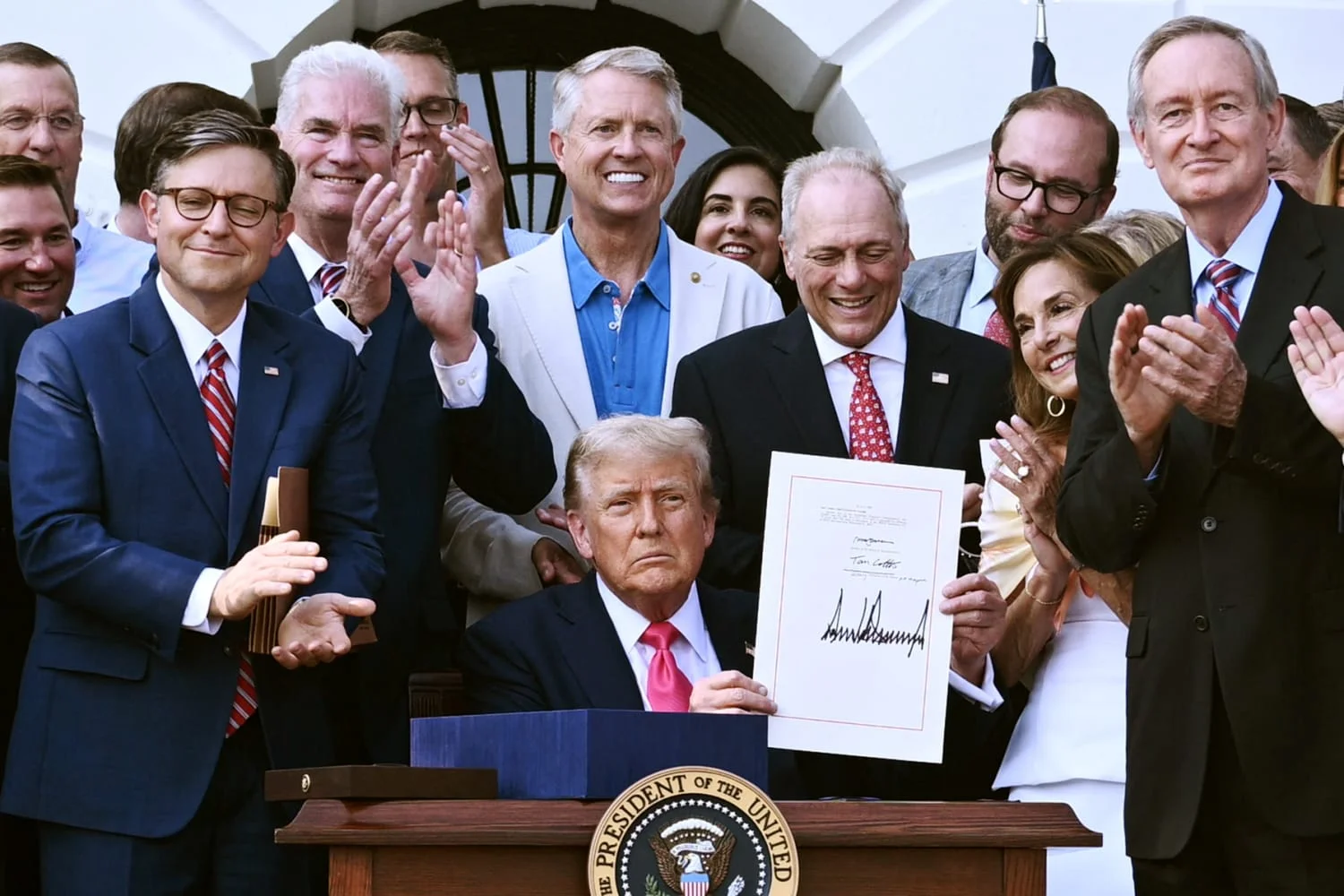
Just a few weeks ago, as families across the country grilled hot dogs and lit fireworks for Independence Day, President Donald Trump signed into law the One Big Beautiful Bill Act. The bill was quickly celebrated in Fox News op-eds and scrutinized by MSNBC commentators. But whether it truly helps the working class, as Trump claims, is where the political divide sharpens.
Right-leaning media outlets highlight popular provisions such as eliminating taxes on tips and overtime, and offering tax cuts for the working class. Critics on the left argue the bill causes more harm than good, citing cuts to Medicaid and SNAP benefits, and claiming the legislation disproportionately favors the wealthy.
So what’s actually in the bill? The White House has published a “Myth vs. Fact” page for the OBBBA, but let’s break down the fine print and see how the claims hold up.
Taxation on Tips and Overtime
Displayed on the White House website are clickable headers titled “No Tax on Tips,” “No Tax on Overtime,” and “No Tax on Social Security.” These refer to Sections 70201, 70202, and 70103 of the bill. However, the law doesn’t exactly eliminate taxes on tips or overtime. What it does is provide annual deductions: up to $25,000 for tips and $12,500 for overtime. These deductions phase out for individuals with an adjusted gross income (AGI) above $150,000, or $300,000 for joint filers.
Section 224 under 70201 defines a “qualified tip” as a cash tip, meaning tips received from customers directly or via credit card, including tip-sharing arrangements. This excludes mandatory service charges added by businesses, which may not qualify.
Still, for many service workers in tip- and overtime-heavy jobs, these deductions could result in significant savings, especially those earning under the AGI threshold. The White House estimates average savings of $1,300 and $1,400 annually, respectively.
Social Security
The claim that there is “no tax on Social Security” is misleading. Section 70103 introduces yet another deduction of up to $6,000 for taxpayers aged 65 and older, lasting through 2028. This deduction begins to phase out for seniors with AGIs over $75,000.
The White House asserts that 88% of seniors will now pay no tax on their Social Security income, which is technically accurate. However, in a separate article praising the Bill, it notes that 64% of seniors already receive tax breaks. While the additional 24% coverage is notable, presenting it as revolutionary is a stretch.
According to Alex Durante of the Tax Foundation, the new deduction primarily benefits middle-income seniors rather than the poorest. Those in the 20th–40th income percentiles see their after-tax income rise by 0.9% under the OBBBA, compared to just 0.1% for those in the bottom 20%. These people were already exempt from taxation with the standard deduction.
So while more seniors will save money between 2025 and 2028, it’s middle-income retirees who stand to gain the most, while the poorest see little to no benefit. As Durante notes, the temporary nature of this policy adds to the bill’s deficit impact without improving long-term economic growth.
Myth vs. Fact
The White House’s five-page “Myth vs. Fact” document aims to clear the air of unsubstantiated liberal attacks. The foremost mentioned myth is that the OBBBA disproportionately cut taxes for the rich while leaving behind the working and middle classes. The White House presents the bill as a huge win for the working class, claiming that it is the “most pro-growth, pro-worker, pro-family legislation ever crafted.”
With the Tax Cuts and Jobs Act from Trump’s first term set to expire in 2025, the OBBBA makes many of its provisions permanent, including lower income tax rates across all brackets. The Child Tax Credit, which was increased from $1,000 to $2,000 under the TCJA, is preserved but not expanded, despite the White House’s framing.
Perhaps the most misleading claim is that the bill increases “take-home pay by over $10,000 per year for a typical family.” This projection assumes a very specific scenario: a family with children, not in the lowest tax bracket, with income from overtime or tips, and eligible for every new deduction. In reality, few families meet all those criteria.
The “Myth vs. Fact” section seems to trade one set of myths for another.
Corporate Tax Benefits
While much of the public focus has been on deductions for individuals, the OBBBA also delivers significant tax benefits to corporations. Several provisions finalize the business-friendly framework introduced during Trump’s first term.
Firstly, the OBBBA makes the 21% corporate tax rate permanent. Originally set to end after 2025, this rate, which is reduced from 35% prior to the TCJA, now becomes a fixture of the U.S. tax code.
Section 70301 permanently reinstates 100% bonus depreciation for qualified business property by amending the Internal Revenue Code. This means companies can immediately deduct the full cost of assets, such as equipment, vehicles, and machinery, placed in service after January 19, 2025, instead of depreciating them over several years.
By removing the phasedown schedule previously introduced under the 2017 Tax Cuts and Jobs Act, the OBBBA ensures that full expensing remains part of the tax code going forward. This move is intended to stimulate business investment and increase cash flow, especially in capital-intensive sectors.
In short, while the White House may brand OBBBA as a pro-worker bill, a deep dive into its tax structure shows that it heavily favors corporate interests.
Written by
William Drummy
Writer at DDQ Review