Trump Rebukes Supreme Court in State of the Union Address After Tariff Defeat
By William Drummy
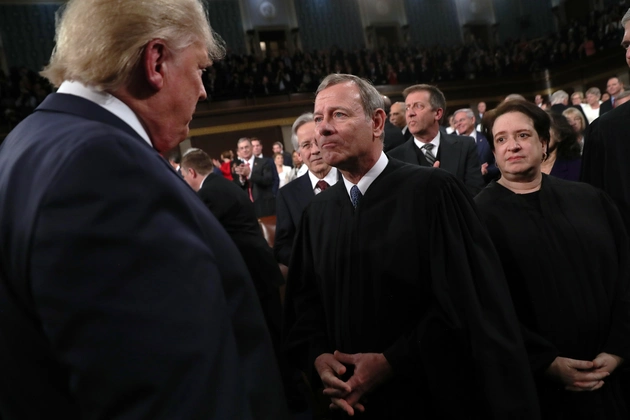
President Trump, just days ago, used his State of the Union address to criticize a Supreme Court ruling that struck down his use of emergency powers to impose sweeping tariffs. As President Trump delivered an emotive State of the Union address on February 24, 2026, to celebrate his administration’s achievements over the last year and a month, four Supreme Court Justices watched from the front row.
It isn’t unusual for roughly half of the United States’ highest court to show up for the State of the Union – only five did so two years ago for Joe Biden’s State of the Union address in 2024. What is abnormal is for the President of the United States to actively express his disappointment with a recent ruling by the Supreme Court. In this case, Trump referred to the recent striking down of his tariff policy under the International Emergency Economic Powers Act (IEEPA). Trump had attempted to use the IEEPA to justify his sweeping global tariffs since the Act “empowers the President to exercise an array of economic powers ‘to deal with any unusual and extraordinary threat’.” Trump claimed two specific “unusual and extraordinary” threats made his imposition of tariffs valid. The first was drug trafficking out of Mexico, Canada, and China; the second was “large and persistent” trade deficits. In response to drug trafficking, Trump levied a 25% tax on many Mexican and Canadian imports, and a 10% tariff on most Chinese imports. In response to the trade deficit, he listed a sweeping tariff of 10% on all imports from trading partners of the United States, with many of these partners being with many trading partners facing even higher rates.
In a 6-3 decision, the Supreme Court ruled that IEEPA did not authorize Trump’s tariffs. The three dissenting justices were the conservative Brett Kavanaugh, Clarence Thomas, and Samuel Alito. The majority opinion included the three Democrat-appointed justices, but also Chief Justice John Roberts, and justices Neil Gorsuch and Amy Coney Barrett.
Chief Justice Roberts concluded, in his majority opinion, that the IEEPA allows the President to “‘investigate, block during the pendency of an investigation, regulate, direct and compel, nullify, void, prevent or prohibit . . . importation or exportation.’” However, unless one is to interpret the language of “regulating…importation” as the power to introduce sweeping and reciprocal tariffs, this list does not authorize Trump’s actions. The word regulate, as commonly understood, has never applied to taxation. As Roberts explains, many states grant the Executive the power to regulate, yet the executive is never given the power to tax. Furthermore, no President has ever invoked the power to raise revenue under IEEPA.
In his State of the Union speech, Trump mentioned how “just four days ago, an unfortunate ruling from the United States Supreme Court, it just came down, a very unfortunate ruling,” which was met with hesitant claps throughout the House Chamber.
Although Trump’s attempt to impose tariffs without congressional approval has been blocked for now, he has said he will seek alternate routes to revive the policy. He pointed to Section 122 of the Trade Act of 1974 as a possible alternative route for imposing temporary tariffs. The section is part of the 1974 Trade Act, and allows for temporary tariffs of up to 15% for 150 days, which can be extended by an Act of Congress. The courts will now have to decide the validity of these new claims.
Written by
William Drummy
Writer at DDQ Review