The Substanceless Meeting Between Trump and Xi
The Chinese and American Presidents met last week in Washington D.C., but little was actually accomplished
By William Drummy
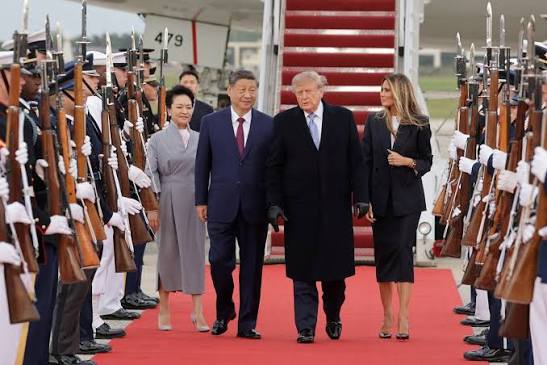
Donald Trump and Xi Jinping met in Washington, D.C., from September 23 to September 25 following an earlier meeting this year in Beijing that spanned from May 13 to May 15. Some of the key talking points from the summit included tariff reductions and a trade truce extension, artificial intelligence, and Taiwan. However, many political commentators and reporters have noted that very little real substance came out of the summit, and instead it mostly included rhetoric and symbolism from the two Presidents.
Bonny Lin from the Center for Strategic and International Studies noted that during Xi’s dinner toast, he painted the United States-China relationship as one defined by friendship, while ignoring the many tensions between both countries, past and present. What Lin called Xi’s “history lesson” mentioned what the United States had taken or received from China, and the fact that the two countries were allied with each other against Japan in World War II. Lin interpreted the latter of those two as trying to drive a wedge between the United States and Japan.
Xi’s rhetoric during the toast reflects a broader strategy that has consistently been important to Chinese foreign policy: illuminating a positive history between China and other countries while minimizing periods of disagreement or tension. Julia Strauss’ 2009 article, “The Past in the Present: Historical and Rhetorical Lineages in China's Relations with Africa,” shows how the true Chinese relationship with Africa has been one of ebbs and flows, where at times during the 20th century, China prioritized its relationship with the West, but when the West wasn’t as willing to cooperate with China, it would turn to prioritizing its relationship with Africa. Just as Chinese leaders have left out the times when they essentially abandoned Africa to try and move up in global status, Xi decided to lead conversation at the dinner table with a history of an only positive and tensionless relationship with the United States. Rhetoric that emphasizes positive bilateral relationships has clearly remained a vital part of Chinese foreign policy, whether it be with a Global Power like the United States, or smaller countries in Africa.
Lin also noted how China did not commit to stop coercing its neighbors, directly referencing the Global South. Instead, during the summit, “Beijing blocked Manila’s resupply of Second Thomas Shoal and then launched a military exercise.” It’s the first time that China has blocked the Philippines’ fleets since 2024, possibly signaling some growing tensions in the region.
Iran was also brought up, as Trump said Iran can never have a nuclear weapon, while Xi only insisted that they cannot develop nuclear weapons. Another CSIS expert, Thomas J. Christensen, said that China “will likely help Iran rebuild its conventional military.” While the U.S. has remained enemies with Iran, China seems committed to acting as an economic partner to the unstable Middle East. However, China also plays the Middle East very strategically, as it may back Iran economically, but is hesitant to intervene in the region militarily.
Another major topic of conversation during the summit was Taiwan, as Xi, according to David Sacks from the Council on Foreign Relations, called on Trump to ‘persist’ in opposing Taiwan’s independence, indicating that Trump has shifted his attitude towards Taiwan. Washington currently has a proposed $14 billion arms sale to Taiwan on hold, which would indicate that Trump’s opinion on Taiwan is definitely not one opposed to their independence. Furthermore, administration officials stated that U.S. policy toward Taiwan remains unchanged, and Trump has not publicly opposed Taiwanese independence.
Taiwan remains one of the most important and potentially dangerous points of disagreement between Washington and Beijing. China has consistently pressured countries around the world to oppose Taiwanese independence and recognize Beijing’s position that Taiwan is part of China. A more explicit statement from Trump opposing Taiwanese independence therefore would have represented a significant diplomatic victory for Xi. Instead, the summit appears to have produced little movement on the issue, leaving the fundamental disagreement between Washington and Beijing intact.
All in all, I thoroughly agree with the analysts who have said that nearly nothing of substance came out of this meeting. Sacks opened his article by calling it a cliché to note that meetings between the two leaders are high on symbolism and low on substance. Even so, this one “may have set a new high-water mark for symbolism and a new low for substance.”
Artificial intelligence was one such area that I was looking forward to paying attention to for this summit. Instead, the two agreed that it is to be renamed to “super intelligence” and discussed further at another summit in November. Before the summit, Margaret Myers from ACF commented that “talks on AI are especially pressing amid mounting public concern over safety, and businesses on both sides are hoping for favorable economic outcomes.” Instead, we will need to wait about two months before these talks resume.
The White House posted a fact sheet to outline the positives that came out of the summit for Americans, claiming that President Trump “advanced the U.S.-China relationship and put the American people first.” Some of the highlights for the administration were a tariff treatment for $30 billion of non-sensitive goods in each direction, a crackdown on fentanyl, and the arrival of two giant pandas, leased by China to the Atlanta Zoo. The only note on artificial intelligence was the agreed-upon name change; there was no mention of Taiwan, and the White House misrepresented Xi’s words about Iran, claiming that both leaders agreed that Iran can never have a nuclear weapon.
For a summit involving the leaders of the world’s two most powerful countries, the lack of meaningful agreements was disappointing, but perhaps expected. There were plenty of ceremonial moments and promises of continued negotiations, but very few signs that the major disputes defining the U.S.-China relationship are any closer to being resolved. The two leaders will apparently have another opportunity to change that when discussions resume in November. For now, however, symbolism remains the clearest product of the summit.
Written by
William Drummy
Writer at DDQ Review